

How do you choose the density of polyester fiber acoustic panels? Many people’s first reaction to acoustic panels is “the higher the density, the better.” CYATCO ACOUSTIC takes a purchasing perspective, systematically explaining definitions, conversions, and common specifications, and uses practical examples of echo reduction in conference rooms to help you spend your budget wisely.
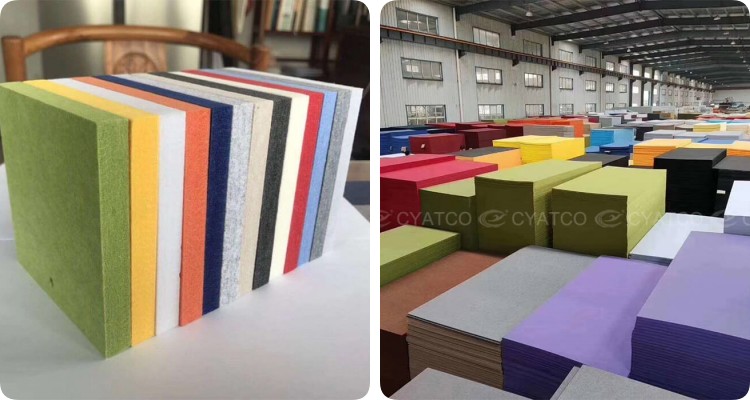
A Comprehensive Analysis of Polyester Fiber Acoustic Panel Density: Reducing Echoes in Conference Rooms – Don’t Just Focus on “The Denser the Better”
Many customers, when purchasing polyester fiber acoustic panels, often begin with:
“What’s the density of your product?”
This question seems technical, but it only gets half the story right.
Density must be determined in conjunction with thickness, usage scenario, sound absorption goals, installation method, budget, and acceptance criteria. Especially in the scenario of reducing echoes in conference rooms, higher density isn’t always better; choosing the right density is key.
This article will clearly explain the density of polyester fiber acoustic panels:
How to read density? How to convert it? How to choose? What to pay attention to when purchasing? What density should you choose for reducing echoes in a conference room?
We suggest saving this article for later reading.
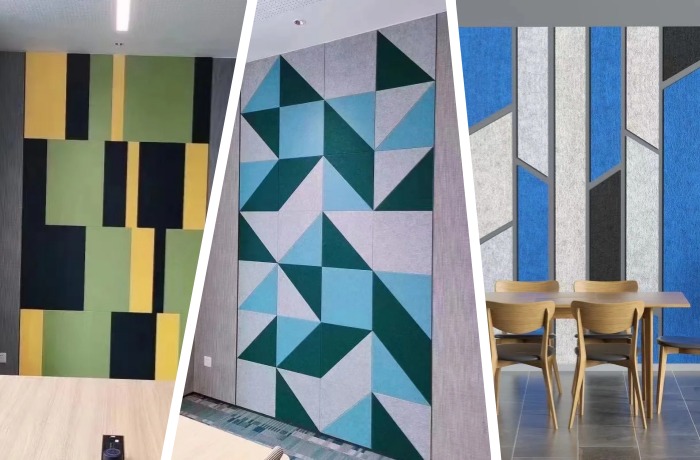
Why is there so much echo in meeting rooms?
Strong echoes in meeting rooms usually aren’t due to a small space, but to the abundance of hard surfaces: glass, tiles, white walls, ceilings, and conference tables all reflect sound.
When people speak, the sound hits these surfaces and reflects, creating significant reverberation and echoes, leading to:
- Difficulty in hearing;
- Clear sound clarity during multi-person meetings;
- Inability to be heard by others in telephone or video conferences;
- Fatigue during long meetings.
Polyester fiber acoustic boards absorb these reflected sounds, reducing reverberation time.
Density is one of the core parameters determining the performance of sound-absorbing panels, directly affecting:
Sound absorption coefficient;
- Board hardness;
- Flexural strength;
- Processability;
- Lifespan;
- Purchase cost.
However, density is never an isolated indicator. When selecting sound-absorbing panels, it must be considered in conjunction with thickness, area, and installation method.
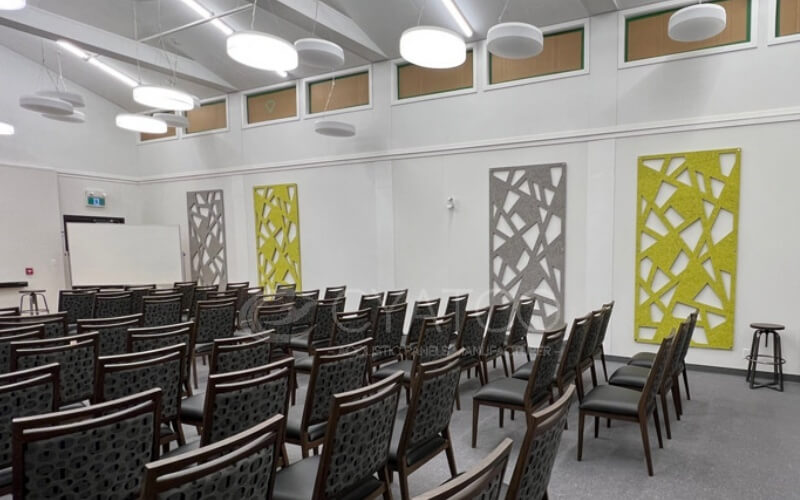
Density has two definitions: areal density and bulk density.
The most common pitfall during procurement is the inconsistency in density definitions.
The density of polyester fiber acoustic board is commonly expressed in two ways:
* Areal Density: g/m² or kg/m²
Areal density refers to the mass of the board per unit area.
For example:
9mm thick, areal density 1500g/m²;
9mm thick, areal density 1900g/m²;
12mm thick, areal density 2400g/m².
Areal density is the most commonly used parameter by manufacturers because it is directly related to thickness, material usage, and cost.
* Bulk Density: kg/m³
Bulk density refers to the mass per unit volume of the material, reflecting the material’s inherent physical properties.
The conversion formula is:
Bulk density (kg/m³) = Surface density (kg/m²) ÷ Thickness (m)
For example:
A 9mm thick board with a surface density of 1800g/m²,
has a surface density of 1.8kg/m²,
and a thickness of 0.009m.
The bulk density is:
1.8 ÷ 0.009 = 200kg/m³
Therefore, when purchasing, be sure to ask clearly:
Is the density you’re referring to surface density or bulk density? What is the thickness?
Otherwise, it’s easy to encounter the mismatch of “high nominal density, but average actual material usage”.
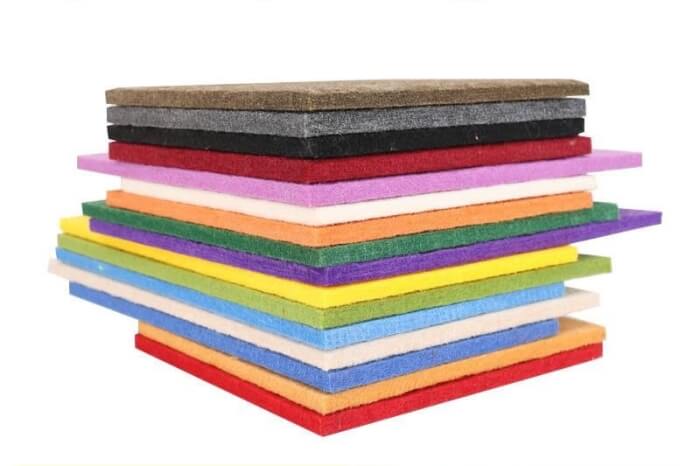
Common Density Specifications
Polyester fiber acoustic boards have a wide density range. Common specifications are roughly as follows:
| Thickness | Common Surface Density | Estimated Bulk Density |
| 9mm | 1300–1900g/m² | 144–211kg/m³ |
| 12mm | 1700–2400g/m² | 142–200kg/m³ |
| 15mm | 2000–2800g/m² | 133–187kg/m³ |
Some high-performance products can achieve even higher bulk densities, and the price will increase significantly accordingly.
The domestic industry standard JC/T 2704-2022 “Polyester Fiber Decorative Acoustic Boards” clearly specifies the surface density. For example, the surface density of a 5mm thick panel should be between 1.38–1.58 kg/m².
When purchasing, it’s best to request a sound absorption coefficient test report from the supplier based on GB/T 20247 (reverberation chamber method) to verify whether the actual acoustic performance matches the nominal density.
Once you receive the test report, focus on three key areas:
- NRC (Noise Reduction Coefficient): This is the average of the sound absorption coefficients at four frequencies: 250/500/1000/2000 Hz. A higher value indicates stronger overall sound absorption; values above 0.85 are generally considered excellent.
- Frequency Curve: Sound absorption coefficients vary at different frequencies. For conference rooms, focus on mid-to-high frequency performance (250Hz–4kHz), while for lower frequencies, focus on the 125–250Hz range.
- Issuing Institution: Prioritize reports from CMA/CNAS accredited laboratories. Third-party reports are more reliable and prevent “manufacturer self-testing and self-certification.”
Understanding these three points will help you determine the credibility of the report.
How Does Density Affect Sound Absorption? Higher Isn’t Always Better
Density and sound absorption performance are closely related, but higher isn’t always better; there’s an “optimal balance point.”
1. Appropriately Increasing Density Can Improve Sound Absorption Performance
Within a reasonable range, appropriately increasing density can improve the sound absorption coefficient, especially in the mid-to-low frequency range.
Some high-density polyester fiber sound-absorbing panels can achieve a noise reduction coefficient (NRC) of 0.88–0.94 or higher. For low-frequency noise in the 125–400 Hz range, high-density panels also provide better absorption.
2. Excessive Density May Actually Reduce Mid-to-High Frequency Sound Absorption
If the density is too high, the surface of the panel will be too dense, making it difficult for sound waves to penetrate the material, leading to a decrease in mid-to-high frequency sound absorption efficiency.
Therefore, the highest density isn’t necessary in all scenarios.
3 Reducing Echoes in Conference Rooms Primarily Focuses on Mid-to-High Frequency
The main sound in a conference room is human voices, concentrated in the 250Hz–4kHz range, which falls under mid-to-high frequency sound absorption. Normal to mid-to-high density is sufficient for this.
Instead of blindly increasing density, focus your budget on:
Sufficient installation area;
Reasonable installation location;
Appropriate cavity design;
Qualified testing reports.
These measures are often more effective than simply increasing density.
4. Distinguish: Sound Absorption ≠ Sound Insulation
Many people confuse “sound absorption” and “sound insulation,” but they are two different things.
Sound-absorbing panels absorb reflected sound within the room, reducing echoes and reverberation; sound insulation, on the other hand, blocks sound from propagating outwards, such as preventing sound from a meeting room from reaching the next room.
For a meeting room:
To speak more clearly with less echo, use sound-absorbing panels;
To ensure the next room can’t hear you, sound-absorbing panels alone are not enough; you also need soundproof walls, soundproof doors, etc.
Understanding this distinction will prevent you from buying the wrong products and wasting your budget.
7 Key Considerations for Polyester Fiber Acoustic Absorbing Panels Density
If you are purchasing polyester fiber acoustic absorbing panels, consider the following 7 issues regarding density:
1. Define the Usage Scenarios
Offices, meeting rooms, classrooms: Standard density is sufficient;
Recording studios, practice rooms, home theaters: Consider high density;
Gyms, corridors, public spaces: Require higher physical strength.
2. Use Standard Density Units
When requesting a quote, clearly request the supplier to specify:
Thickness;
Surface density (g/m²);
Bulk density (kg/m³);
Testing standards;
Sound absorption coefficient report.
Avoid vague terms like “high density,” “thickened,” or “premium.”
3. Balance Acoustic Performance
High density does not necessarily equal high sound absorption.
Consider NRC, frequency response curves, and installation methods.
Especially for low-frequency control, don’t just look at density; also consider thickness and cavity size.
4. Assess Physical Durability
High-density fiberboard (HDF) feels solid, has good springback when pressed, and is less prone to shedding lint and dust when cut.
Low-density fiberboard (LDF) is softer, dents easily when pressed, and its edges are prone to fraying.
High-density fiberboard is more advantageous for carving, chamfering, and irregular shaping.
5. Weight Costs
Market Reference Prices:
Standard Engineering Grade 9mm: Approximately 25–40 RMB/㎡;
High-Density Premium Grade 9mm/12mm: Approximately 40–70 RMB/㎡.
Actual prices may vary.
Low-density fiberboard is cheaper initially, but may require rework due to insufficient sound absorption and susceptibility to damage, so its total lifespan cost may not be lower.
6. Acceptance According to Standards
Upon arrival, you can:
Weigh individual sheets of fiberboard;
Calculate surface density;
Check for uniform density;
Check for looseness and shedding.
7. Supplier Communication and Sample Verification
Always request samples before bulk purchases.
Three things to do with the sample:
Weigh and calculate density;
Test hardness by pressing;
Cut and observe the edges for shedding.
Also, request a third-party testing report, such as one issued by an SGS or CMA/CNAS certified laboratory.
*Supplement: Fire Resistance and Environmental Protection – Don’t Ignore These in Procurement
Besides density, fire resistance and environmental protection ratings are also crucial indicators when purchasing sound-absorbing panels, especially for public spaces and conference room projects.
- Fire Resistance: Prioritize products that meet B1 standards, as many public building projects have strict requirements for combustion performance;
- Environmental Protection: Pay attention to formaldehyde emissions, choosing boards that meet E0 or E1 standards to avoid exceeding indoor air quality standards after renovation;
- Certificates: Request fire resistance and environmental protection test reports during procurement, and keep them on file along with the sound absorption report.
Only when all three aspects are met can the product truly be considered “suitable for conference rooms”.

Reducing Echo in Conference Rooms: Which Density to Choose?
If your scenario involves reducing echo in a conference room, you can choose from the following options:
- Recommended Option 1: 9mm, surface density 1500–1900 g/m²
Equivalent to a volumetric density of approximately 170–210 kg/m³.
Suitable for most conference rooms, offices, and training rooms.
High cost-performance ratio; sufficient for mid-to-high frequency sound absorption.
- Recommended Option 2: 12mm, surface density 1800–2400 g/m²
Equivalent to a volumetric density of approximately 150–200 kg/m³.
Thicker material with a more stable structure, suitable for conference rooms with higher sound quality requirements or those needing some low-frequency control.
- Budget-limited option: 9mm, surface density 1300–1700 g/m²
Equivalent to a volumetric density of approximately 145–190 kg/m³.
Usable, but the material is relatively soft, and the edges may shed. Suitable for budget-sensitive projects focusing on mid-to-high frequency echo reduction.
Not recommended: Directly using 24mm ultra-high density boards for echo reduction.
Conference room echo reduction primarily addresses human voices and mid-to-high frequencies. Ultra-high density boards are expensive, but their mid-to-high frequency absorption may not improve linearly.
The sound-absorbing area, placement, and whether a cavity is left are often more critical than simply increasing density.
Installation Method: Easily Overlooked Compared to Density
The same sound-absorbing board can have significantly different sound absorption effects depending on the installation method.
Directly attached to the wall: Simple construction, suitable for mid-to-high frequency absorption;
With a joist and cavity: Can improve low-frequency absorption;
Ceiling installation:
Significantly helps with overall reverberation control;
First reflection point on the wall:
Prioritize placement for a more direct effect.
Conference room recommendations for priority treatment:
First reflection points on both side walls;
Rear wall;
Ceiling;
Reflective surfaces near video conferencing cameras.
If only high-density boards are purchased but only a small piece is installed, echoes will still be noticeable.
Before Purchasing, Ask Yourself 3 Questions
1. In what scenario will it be used? What type of noise will it primarily address?
Is it for reducing echo in a conference room, or for low-frequency control in a recording studio?
2. What density specifications are required? What are the target thickness and density?
Is it surface density (g/m²) or bulk density (kg/m³)?
Do you plan to use 9mm, 12mm, or 15mm?
3. What is most important?
Is meeting sound absorption standards, board hardness, no shedding during processing, lowest price, or a third-party testing report required?
Thinking through these 3 questions will significantly improve communication efficiency with suppliers.
Summary: Density is Key, But Not the Only Factor
The density of polyester fiber acoustic boards is indeed important.
However, you shouldn’t only look at density when purchasing, and you certainly shouldn’t blindly believe that “the denser the better.”
Remember these three points:
1. Surface density depends on the materials used, bulk density depends on the material properties, and procurement should adhere to consistent standards.
2. To reduce echo in meeting rooms, choose high-density materials. Pay close attention to the area, location, and installation.
3. Standards, reports, and sample verification are all essential.
Choosing the right density, thickness, and installation method is crucial to truly eliminate echoes in your meeting room and make meetings more comfortable.
If you are looking to improve sound absorption and noise reduction for your meeting room, office, or home theater, please contact us with your space area, ceiling height, usage scenario, and budget. We can help you determine the appropriate density, thickness, coverage area, and construction plan, ensuring every penny of your budget is well spent.
Polyester fiber acoustic panels are not about being as dense as possible; the more suitable, the better.